

Introduction
Choosing an influencer marketing partner can determine whether your campaign delivers measurable business growth or drains your marketing budget. Knowing how to choose an influencer marketing agency is one of the most important decisions a brand can make because the right agency helps you find authentic creators, manage campaigns efficiently, and generate measurable ROI, while the wrong one can damage your brand reputation and waste valuable resources.
Today, influencer marketing has evolved far beyond simply paying creators to post on social media. Modern campaigns require strategic planning, creator vetting, performance tracking, compliance, and data-driven decision-making. As brands across Nigeria, Ghana, Kenya, and the rest of Africa increase their investment in creator marketing, choosing the right agency has become more important than ever.

Unfortunately, many agencies promise impressive reach, viral campaigns, and instant sales without providing evidence of their capabilities. Some rely on vanity metrics instead of meaningful business outcomes, while others lack the systems needed to identify genuine creators or measure campaign success accurately.
This guide explains how to choose an influencer marketing agency by highlighting seven warning signs that every business should recognize before signing a contract. You’ll also discover practical evaluation criteria, a hiring checklist, and learn what separates exceptional agencies from average ones.
Table of Contents
Why Choosing the Right Influencer Marketing Agency Matters
Many businesses assume every influencer marketing agency offers similar services. In reality, the quality of agencies varies significantly. Some focus only on connecting brands with influencers, while others provide comprehensive campaign management, creator discovery, performance optimization, and post-campaign reporting.

Understanding how to choose an influencer marketing agency begins with recognizing that your agency should function as a strategic partner, not simply a middleman between your business and creators.
The right partner helps you:
- Identify creators whose audiences genuinely match your target market.
- Develop campaign strategies aligned with your marketing objectives.
- Negotiate fair creator partnerships.
- Monitor campaign performance using reliable analytics.
- Optimize campaigns based on real-time insights.
- Measure business outcomes instead of vanity metrics.
By contrast, a poor agency often prioritizes speed over strategy, resulting in weak creator matches, low engagement, and disappointing returns.
The Cost of Hiring the Wrong Agency
Knowing how to choose an influencer marketing agency is very essential. Selecting the wrong influencer marketing agency can affect far more than your advertising budget.
Some of the most common consequences include:
1. Financial Losses
Without proper creator vetting or campaign planning, brands often pay for collaborations that generate little engagement or fail to reach their intended audience.
2. Damaged Brand Reputation
Partnering with influencers who have fake followers, controversial histories, or audiences unrelated to your industry can negatively affect public perception.
3. Missed Growth Opportunities
Poor influencer selection means your competitors may capture the attention and loyalty of the audience you intended to reach.
4. Inaccurate Campaign Reporting
Some agencies provide reports focused solely on impressions and likes without explaining how campaigns contributed to website traffic, lead generation, or sales.
Ultimately, learning how to choose an influencer marketing agency helps businesses reduce these risks while maximizing the value of every campaign.
What Great Agencies Do Differently
Exceptional influencer marketing agencies distinguish themselves through processes rather than promises.
Instead of chasing viral moments, they focus on sustainable, repeatable campaign success.
Some characteristics include:
1. Rigorous Creator Vetting
Professional agencies verify audience authenticity, engagement quality, content consistency, and brand safety before recommending creators and thats result when you know how to choose an influencer marketing agency for your campaign.
2. Strategic Campaign Planning
Every campaign begins with clearly defined objectives, target audiences, KPIs, budgets, timelines, and measurement frameworks.
3. Transparent Communication

Great agencies openly explain pricing structures, deliverables, timelines, and expected outcomes.
4. Data-Driven Decision Making
Campaign decisions rely on measurable performance indicators rather than assumptions or follower counts.
5. Long-Term Partnership Approach
Rather than treating campaigns as one-off projects, leading agencies help brands develop lasting creator relationships that improve campaign performance over time.
These capabilities become especially valuable when executing campaigns across multiple African markets, where audience behaviors and creator ecosystems differ between countries.
How to Choose an Influencer Marketing Agency
Before diving into specific red flags, it helps to have a structured way of evaluating any agency you’re considering. Here is a straightforward four-step framework that brands and marketing managers can use.

Step 1: Define your campaign objective first. Are you trying to build brand awareness, drive e-commerce sales, launch a new product, or grow your social following? Your objective determines what type of agency and creator mix you need. A performance marketing campaign on TikTok requires a very different partner than a B2B thought leadership campaign on LinkedIn.
Step 2: Know your creator tier needs. Micro influencers (typically 10,000–100,000 followers) often deliver stronger engagement and niche audience alignment. Macro influencers and UGC creators serve different purposes. An agency that defaults to recommending the same tier for every brand is not thinking strategically about your campaign.
Step 3: Evaluate the agency’s verification process. Before you can trust their results, you need to trust their creator roster. Ask directly: how do you vet creators, and what data do you use to verify audience authenticity?
Step 4: Demand transparency before commitment. Ask to see real campaign reports from previous clients (anonymised if necessary). Ask about pricing structure in detail. Ask what happens if a creator underperforms. An agency that answers these questions confidently and openly is one that has nothing to hide.
Knowing how to choose an influencer marketing agency starts with clarity on your own needs and it ends with rigorous questioning of potential partners.
- Do they explain their creator vetting process?
- Can they demonstrate previous campaign outcomes?
- How do they measure campaign ROI?
- What reporting will I receive?
- How often will they communicate campaign progress?
- Do they support campaigns across multiple African markets?
- Can they scale campaigns as my business grows?
Answering these questions provides a clearer picture of whether an agency can deliver meaningful business outcomes rather than simply executing influencer collaborations.
7 Red Flags to Watch For
1 – No Transparent Creator Vetting Process
One of the clearest warning signs is an agency that cannot explain how it evaluates creators.
Without a structured vetting process, brands risk collaborating with influencers whose audiences are inflated by fake followers, bots, or low-quality engagement.
Why it’s dangerous
Poor creator selection leads to wasted budget, weak engagement, and campaigns that fail to reach the intended audience.
How to spot it
- The agency focuses only on follower counts.
- It cannot explain audience verification methods.
- It avoids discussing engagement quality or audience demographics.
Questions to ask
- How do you verify creator authenticity?
- What metrics determine creator quality?
- How often is creator data updated?
Better alternative
Choose a partner that prioritizes creator vetting, audience authenticity, and relevance over vanity metrics.
2 – Fake Engagement and Inflated Metrics
Likes and follower counts don’t always reflect real influence.
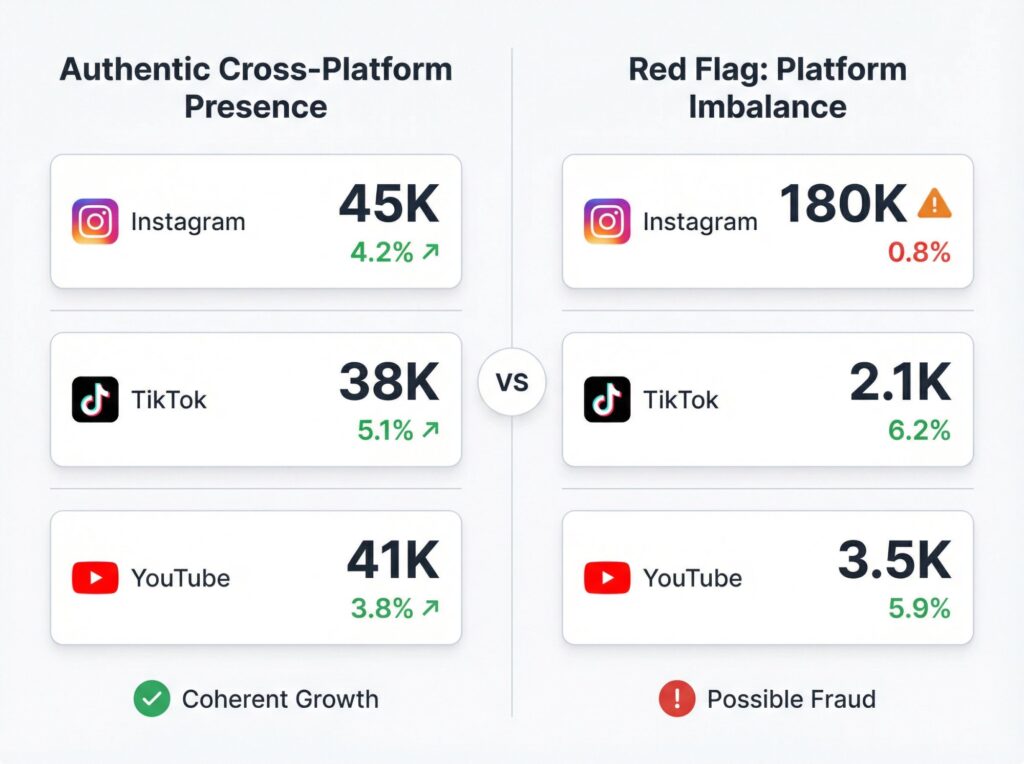
Some agencies present impressive numbers without explaining whether those metrics translate into meaningful business outcomes.
Why it’s dangerous
Inflated engagement can create the illusion of success while delivering little value to your business.
How to spot it
- Reports focus only on likes and impressions.
- Conversion metrics are missing.
- Audience quality isn’t discussed.
Questions to ask
- Which KPIs do you measure?
- How do you calculate campaign ROI?
- What reporting dashboard do clients receive?
Better alternative
Work with agencies that prioritize meaningful KPIs such as website traffic, conversions, qualified leads, sales, engagement quality, and return on investment.
3 – No Clear Campaign Strategy
Some agencies begin contacting creators before defining campaign objectives.
This approach often leads to inconsistent messaging, unclear expectations, and disappointing outcomes.
Why it’s dangerous
Without a strategy, even talented creators struggle to deliver meaningful results.
How to spot it
- No discussion of campaign objectives.
- Vague timelines.
- Limited creative guidance.
- No defined KPIs.
Questions to ask
- What is your campaign planning process?
- How do you define success?
- How do you align creators with our brand goals?
Better alternative
Choose agencies that develop detailed campaign briefs, audience personas, content guidelines, KPIs, and optimization plans before creators are selected.
4 – Poor Reporting and Analytics
Campaigns shouldn’t end when creators publish their content.
The best agencies continually monitor performance and provide transparent reporting that helps brands improve future campaigns.
Why it’s dangerous
Without actionable insights, businesses cannot understand what worked, what didn’t, or how to improve ROI.
How to spot it
- Reports arrive weeks late.
- Dashboards lack transparency.
- Metrics focus only on reach.
- Recommendations for future optimization are absent.
Questions to ask
- How frequently do you report campaign performance?
- Can we access real-time dashboards?
- Which attribution methods do you use?
5 – Limited Industry Experience
Not every influencer marketing agency has experience in every industry. An agency that excels at promoting beauty products may not have the expertise to run campaigns for B2B SaaS, financial services, healthcare, manufacturing, or enterprise technology.
This doesn’t mean the agency isn’t capable, but it does mean you should evaluate whether it understands your customers, buying journey, compliance requirements, and business objectives.
Why it’s dangerous
Industry experience influences everything from creator selection to messaging and campaign goals. An agency unfamiliar with your sector may recommend creators who generate engagement but fail to reach decision-makers or qualified buyers.
For example, a SaaS company selling HR software to enterprise clients needs a very different influencer strategy than a fashion retailer targeting Gen Z consumers. In the first case, LinkedIn creators, industry experts, and thought leaders may be more valuable than lifestyle influencers with large Instagram followings.
How to spot it
Watch for these warning signs:
- The agency cannot explain how influencer marketing differs across industries.
- Their portfolio contains only one type of client.
- Case studies focus on vanity metrics instead of business outcomes.
- They struggle to discuss your target audience in detail.
Questions to ask
- Have you managed campaigns in our industry?
- Can you share relevant examples?
- How would your strategy differ for our audience?
- Which creator categories would you recommend and why?
Better alternative
Look for an agency that demonstrates curiosity, strategic thinking, and a willingness to tailor campaigns to your objectives instead of relying on a one-size-fits-all approach.
6 – Hidden Pricing and Unclear Contracts
Pricing should never feel like a mystery.
Some agencies advertise attractive entry prices but introduce additional fees for campaign management, creator negotiations, reporting, revisions, or platform access later in the process.
Why it’s dangerous
Unexpected costs make budgeting difficult and can quickly turn an affordable campaign into an expensive one.
Hidden contract terms may also limit your ownership of campaign assets, restrict creator usage rights, or create long-term commitments that don’t align with your business needs.
How to spot it
Be cautious if:
- Pricing changes after initial discussions.
- Deliverables are vaguely described.
- Contracts lack clear timelines.
- Ownership of creative assets isn’t specified.
- Reporting is treated as an optional extra.
Questions to ask
- What exactly is included in your pricing?
- Are creator fees included?
- Are there setup or onboarding charges?
- Who owns the campaign content?
- What happens if campaign objectives change?
Better alternative
Choose partners that provide transparent proposals outlining deliverables, timelines, pricing, reporting, payment schedules, and campaign responsibilities before work begins.
7 – No Long-Term Campaign Support
Many agencies excel at launching campaigns but disappear once the content goes live.
Successful influencer marketing isn’t about publishing one post,it’s about continuously improving results through testing, optimization, reporting, and relationship building.
Why it’s dangerous
Without ongoing support:
- Campaign insights are lost.
- High-performing creators aren’t retained.
- Lessons aren’t applied to future campaigns.
- ROI becomes difficult to improve over time.
How to spot it
Ask whether the agency offers:
- Campaign optimization
- Ongoing reporting
- Creator relationship management
- Performance reviews
- Recommendations for future campaigns
If the answer is “the campaign ends after content is published,” that’s a significant warning sign.
Better alternative
The strongest influencer partnerships evolve over time. Agencies should continuously analyze campaign performance, identify repeat collaboration opportunities, and refine creator selection based on previous results.
Checklist for Choosing the Best Influencer Marketing Agency
Use this checklist before signing with any agency.
1. Strategy
- They understand our business goals.
- They define measurable KPIs.
- They recommend the right creator mix.
- They explain campaign strategy clearly.
2. Creator Quality
- Creators are verified.
- Audience authenticity is checked.
- Engagement quality is evaluated.
- Brand safety reviews are conducted.
3. Reporting
- Real-time analytics are available.
- Reports focus on business outcomes.
- ROI measurement is included.
- Optimization recommendations are provided.
4. Transparency
- Pricing is clear.
- Contracts are easy to understand.
- Deliverables are documented.
- Communication expectations are defined.
Agency vs. Influencer Marketing Platform: Which Is Right for You?

Not every brand needs a traditional influencer marketing agency. Depending on your goals, budget, and internal capacity, an AI-powered influencer marketing platform may deliver better results faster and at lower cost.
Here’s how the two options compare:
| Factor | Traditional Agency | Influencer Marketing Platform (e.g., Diglancers) |
|---|---|---|
| Cost | Higher : retainers typically $3,000–$25,000/month | More flexible : campaign-based pricing with lower overhead |
| Speed to Launch | 3–6 weeks for onboarding and strategy | Days – AI discovery accelerates creator matching |
| Scalability | Limited by team capacity | Highly scalable : access hundreds of verified creators simultaneously |
| Creator Access | Dependent on agency’s existing relationships | Direct access to a verified creator marketplace |
| Reporting Transparency | Variable : often agency-curated summaries | Direct access to real-time campaign analytics |
| Creator Vetting | Manual process, quality varies by agency | AI-powered verification with audience authenticity data |
| Campaign Management | Fully managed:less brand control | Collaborative – brand maintains strategic oversight |
| Best Use Case | Large campaigns requiring full-service execution | Performance-driven campaigns requiring verified reach and fast activation |
| Regional Expertise (Africa) | Rare – most agencies lack genuine African creator networks | Purpose-built for African markets: Nigeria, Kenya, Ghana, and beyond |
Traditional agencies offer hands-on support, which is valuable when you lack internal marketing resources. But for brands that want transparent data, verified creators, and direct control over campaign performance, especially in African markets, a purpose-built platform delivers more measurable value.
Why Brands Choose Diglancers

Selecting an influencer marketing partner is ultimately about outcomes rather than promises.
Brands increasingly look for solutions that help them:
- Discover verified creators faster.
- Reduce time spent searching for the right influencers.
- Launch campaigns confidently.
- Measure campaign performance transparently.
- Improve ROI over time.
- Scale campaigns across multiple African markets.
Diglancers supports these objectives by combining AI-powered creator discovery with verified creator profiles, campaign management tools, transparent analytics, and performance tracking.
Rather than relying solely on follower counts, the platform encourages brands to make data-informed decisions based on creator relevance, audience quality, campaign objectives, and measurable business outcomes.
This approach is particularly valuable for businesses expanding influencer marketing initiatives across Nigeria, Kenya, Ghana, and the wider African creator economy, where local knowledge and authentic creator relationships are essential.
The result is a more efficient workflow for marketing teams and a stronger foundation for long-term creator partnerships.
Final Thoughts
Choosing an influencer marketing partner is about much more than comparing pricing or reviewing a list of past clients. The right partner should help you build authentic creator relationships, execute campaigns strategically, and measure business outcomes with confidence.
Throughout this guide, we’ve explored the key principles behind how to choose an influencer marketing agency,from evaluating creator vetting processes and campaign strategy to assessing reporting capabilities, pricing transparency, industry experience, and long-term support.
While every business has different objectives, the best agencies consistently share a few characteristics:
- They prioritize authentic creators over vanity metrics.
- They align campaigns with business goals.
- They provide transparent reporting and measurable KPIs.
- They communicate openly throughout the campaign lifecycle.
- They continuously optimize campaigns based on performance data.
As influencer marketing becomes increasingly data-driven, many organizations are also complementing agency expertise with technology that streamlines creator discovery, campaign management, and performance tracking. This combination allows marketing teams to make faster, more informed decisions while maintaining visibility into campaign ROI.
Whether you’re launching your first influencer campaign or scaling an established creator program across Africa, investing time in selecting the right partner will pay dividends in stronger collaborations, better audience engagement, and more sustainable business growth.
Frequently Asked Questions
1. How do I know how to choose an influencer marketing agency?
When evaluating how to choose an influencer marketing agency, focus on creator vetting, campaign strategy, reporting, pricing transparency, communication, industry expertise, and measurable business outcomes rather than follower counts alone.
2. What makes a good influencer marketing agency?
when you have figured out how to choose an influencer marketing agency, the good influencer marketing agency combines strategic planning, verified creator relationships, transparent analytics, campaign optimization, and ongoing support. It should demonstrate how influencer campaigns contribute to your broader marketing objectives.
3. How much does an influencer marketing agency cost?
Pricing varies depending on campaign complexity, creator fees, services provided, and market. Rather than choosing the lowest-cost option, evaluate the overall value, transparency, and expected return on investment.
4. What questions should I ask before hiring an agency?
Some important questions include:
- How do you vet creators?
- Which KPIs do you track?
- Can you share relevant case studies?
- What reporting do clients receive?
- How do you optimize campaigns after launch?
- How is pricing structured?
5. Can small businesses benefit from influencer marketing?
Absolutely. when small businesses gets how to choose an influencer marketing agency that works for them they often achieve excellent results by partnering with niche creators whose audiences closely match their target customers. Well-planned campaigns with micro-influencers can be highly cost-effective.
6. Should I use an influencer marketing platform instead of an agency?
The answer depends on your resources and goals. Businesses seeking greater transparency, faster creator discovery, and scalable campaign management may benefit from an AI-powered influencer marketing platform. Organizations requiring fully outsourced strategy and execution may prefer a traditional agency, while many brands use a combination of both.
7. How does Diglancers help brands find influencers?
Diglancers uses AI-powered creator discovery, verified creator profiles, campaign management tools, transparent analytics, and performance tracking to help brands identify suitable creators and manage campaigns across multiple African markets.
8. What industries benefit most from influencer marketing
Influencer marketing can be effective across many sectors, including e-commerce, consumer goods, technology, SaaS, finance, education, healthcare, hospitality, beauty, fashion, entertainment, and professional services. Success depends on aligning creators with the right audience and business objectives.Because of this, many brands partner with an agency to find the right fit. Here’s how to choose an influencer marketing agency: look for one with experience in your industry, a vetted creator roster, transparent pricing, and clear measurement tied to business goals.
Ready to Launch a Smarter Influencer Campaign?
Choosing the right influencer marketing partner is one of the most important decisions you’ll make for your brand’s growth.
If you’re looking for how to choose an influencer marketing agency or a smarter way to discover verified creators, manage campaigns efficiently, and measure results with confidence, explore how Diglancers helps brands across Africa build authentic creator partnerships backed by AI-powered discovery, transparent analytics, and performance-focused campaign management.
Whether you’re launching your first campaign or scaling influencer marketing across multiple markets, the right tools and trusted creator relationships can help you achieve measurable business outcomes.
